Introduction
With the rapid growth of online trading in India, millions of people are now actively participating in stock market activities such as equity trading, intraday trading, and options trading. Along with legitimate and regulated trading platforms, another term often appears in online searches and discussions — Dabba Trading.
Many people want to understand what a Dabba Trading App is, what kind of work people do in Dabba Trading, and how the Dabba Trading system works. This article explains the complete concept of Dabba Trading in simple and clear English for educational and informational purposes.
What Is Dabba Trading?
Dabba Trading refers to an unofficial trading system where buying and selling of stocks or derivatives happens outside the official stock exchanges such as NSE (National Stock Exchange) and BSE (Bombay Stock Exchange).
In this system, trades are not recorded on the exchange. Instead, they are maintained privately by an operator using internal records, software, or apps. Because these trades stay outside official books, the practice is commonly referred to as “Dabba” (off-the-book trading).
What Is a Dabba Trading App?
A Dabba Trading App is a private or unofficial trading application that allows users to place buy and sell orders similar to real stock trading apps. These apps usually show:
- Live market prices
- Buy and sell options
- Profit and loss (P&L)
- Margin and leverage
However, even though the interface looks professional, the trades executed on a Dabba Trading App do not go to the real stock exchange. Everything remains within the operator’s private system.
What Work Is Done in Dabba Trading?
Many people ask, “What work do people do in Dabba Trading?”
Dabba Trading usually involves multiple roles within a private network.
1. Dabba Trading Operator
The operator is the core person in the system. Their responsibilities include:
- Managing the Dabba Trading App or software
- Creating trading IDs for users
- Controlling margins and leverage
- Handling profits and losses
- Managing settlements and payments
The entire system depends on the operator.
2. Agent or Sub-Broker
Agents act as intermediaries between the operator and traders. Their work includes:
- Bringing new traders to the platform
- Assisting with account creation
- Explaining how the app works
- Helping with deposits and withdrawals
Agents usually operate through personal networks, WhatsApp, or Telegram groups.
3. Trader or Client
A trader is the end user who places trades on the Dabba Trading App. Traders:
- Buy and sell stocks or index contracts
- Trade intraday or in options
- Earn profits or face losses
Traders believe they are trading in the live market, but the trades are only recorded within the private system.
4. Settlement and Accounting Handler
In larger Dabba Trading setups, some people are assigned to:
- Calculate daily profit and loss
- Manage settlements
- Track payments
- Maintain internal records
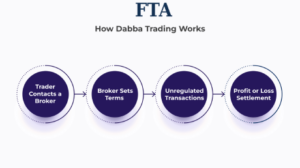
How Does Dabba Trading Work? (Step-by-Step)
Understanding how Dabba Trading works is important to clearly see how the system operates.
Step 1: Creation of Trading ID
The user is given a Dabba Trading ID that is not linked to any SEBI-registered broker. The account is created internally by the operator, usually with minimal or no KYC.
Step 2: Fund Deposit
The trader deposits money directly with the operator or agent. Payments are often made through:
- Cash
- UPI
- Private bank transfers
There is no official escrow or regulated account.
Step 3: Access to Dabba Trading App or Panel
The trader receives login details for a mobile app or web-based trading panel. The interface looks similar to official trading apps and shows real-time market prices.
Step 4: Placing Buy and Sell Orders
When a trader places an order:
- The trade is recorded internally
- No order is sent to NSE or BSE
- The operator acts as the counterparty
Step 5: Profit and Loss Calculation
Based on market price movements:
- Profits or losses are shown in the app
- The calculations depend entirely on the operator’s system
Step 6: Settlement Process
At the end of the trading session or week:
- Profits are paid to the trader
- Losses are collected
- Settlements are handled manually or digitally
Instruments Traded in Dabba Trading
Most Dabba Trading activity focuses on:
- Nifty
- Bank Nifty
- Stock options
- Intraday equity trades
Long-term investing is rare because Dabba Trading is primarily designed for short-term speculation.
Why Is Dabba Trading Popular?
Despite being unofficial, Dabba Trading attracts people due to:
- High leverage
- Low capital requirements
- Quick account setup
- Simple trading interface
- Faster settlements
Advantages of Dabba Trading (Informational View)
From a user perspective, people often mention:
- Higher leverage than official brokers
- No demat account required
- Quick onboarding
- Easy trading access
- Flexible settlement timings
Disadvantages of Dabba Trading
Dabba Trading also involves serious risks, including:
- No regulatory protection
- High dependency on the operator
- Risk of fund loss
- No grievance redressal system
- Accounts can be closed anytime
Legal Aspect of Dabba Trading
In India:
- Only SEBI-registered brokers can legally offer trading services
- Trades must be routed through recognized stock exchanges
Since Dabba Trading operates outside these rules, it is considered unregulated and unofficial. Participants do not receive the legal protections available in official trading systems.
Difference Between Dabba Trading App and Official Trading App
| Feature | Dabba Trading App | Official Trading App |
|---|---|---|
| Exchange Connection | No | Yes |
| Regulation | No | SEBI Regulated |
| Transparency | Low | High |
| Legal Status | Unofficial | Legal |
| Investor Protection | No | Yes |
Why Is Risk Higher in Dabba Trading?
- Operator controls the entire system
- No independent verification
- Possibility of data manipulation
- Payment defaults may occur
- No legal complaint mechanism
Is Dabba Trading Completely Wrong?
This article does not promote or encourage any activity. It is written purely for educational awareness.
Understanding how Dabba Trading works helps people make informed decisions and recognize the difference between regulated and unregulated trading systems.
Frequently Asked Questions (FAQs)
Is a Dabba Trading App real?
The app may function technically, but it is not connected to official stock exchanges.
Is money safe in Dabba Trading?
There is no guaranteed safety, as everything depends on the operator.
Is KYC mandatory in Dabba Trading?
In most cases, KYC requirements are minimal or absent.
Who works in Dabba Trading?
Operators, agents, traders, and settlement handlers.
Conclusion
A Dabba Trading App may look similar to a genuine trading platform, but it works entirely outside official stock exchange systems. People involved in Dabba Trading perform roles such as operating the platform, acting as agents, trading, and managing settlements.
While the system may appear simple and attractive, it is unregulated and carries significant risks. This article aims to explain what Dabba Trading is, what work is done in it, and how it works, purely for educational understanding.